Planning has limits
Cities evolve beyond them
We work within the gap
Between grid and ground
Urban STEPS is an applied research, learning, and strategic framework for understanding and engaging complex urban systems wherever conventional planning alone reaches its limits.
Framework Formation
HOW URBAN STEPS EMERGED
Urban STEPS emerged from over two decades of work by Zahra Breshna across leadership roles in architecture, metropolitan planning, urban heritage, governance, research, and cultural continuity – within complex institutional and post-conflict urban environments.
Rather than originating as a predefined theory, it evolved through recurrent observation and repeated patterns: complex urban environments are increasingly shaped by interconnected social, cultural, institutional, and territorial dynamics that extend beyond what planning instruments alone can fully capture. Urban STEPS was distilled as a framework for reading, engaging, and navigating these underlying systems.
The following timeline highlights key observations and experiences that informed the evolution of Urban STEPS.
ATLAS
Explore recurring patterns, underlying logics, and critical gaps across places, scales, materials, and time.
Selected Atlas Signatures


Understanding cities begins by uncovering their layered histories and underlying structures. Through socio-spatial surveys, mapping, field research, and critical observation, we reveal embedded logics, memory systems, and often overlooked dynamics. This analytical groundwork enables context-sensitive action that is based on evidence, not on assumptions.
Related Atlas


Viable urban change depends on people as much as on plans. URBAN STEPS develops practice-oriented learning formats that reactivate local knowledge, strengthen institutional and community capacities, and foster shared responsibility for shaping resilient urban futures.
Related Atlas


Urban transformation requires translation across boundaries. By connecting tradition and innovation, informal practices and formal institutions, local experience and international expertise, URBAN STEPS creates bridges that allow inherited knowledge to evolve without losing identity, continuity, or coherence.
Related Atlas


Ideas are most transformative when embedded within an organized framework. Planning becomes effective when it translates insight into coordinated action. Rather than imposing fixed solutions, URBAN STEPS uses planning as a strategic instrument to align actors, prioritize interventions, and unlock opportunities within complex and rapidly changing urban environments.
Related Atlas


In conditions of uncertainty, complexity cannot be eliminated—it must be navigated. URBAN STEPS combines adaptive strategies, negotiation frameworks, territorial intelligence, and data-informed analysis to develop flexible responses that evolve with changing realities.
Related Atlas


Research, Publications,
& Urban Discourse
Evolving Discourse
Ideas evolve through practice, publication, and critical reflection. This section traces that ongoing development.


Publications & Early Discourse
Trace the thematic and methodological evolution of Urban STEPS



Concepts & Essays
Concepts emerging from long-term observation, applied practice, and ongoing research.
Selected
GROUND MEETS GRID
The city unfolds between layers of ground that grow and lines of grid that govern.
Understanding how institutional order and lived reality continuously shape one another.
Most cities do not begin on blank slates. They unfold over time through lived practices, improvisations, and self-organization—the Ground. At the same time, they are shaped by laws, plans, and infrastructure—the Grid.
Even where cities are conceived as blank slates, drawn entirely from masterplans, the Ground eventually asserts itself: in unplanned uses, informal economies, and everyday negotiations that no blueprint can fully control.
Both are necessary. Both are fragile. Where one dominates without the other, cities collapse into either chaos or rigidity.
Why the Ground Matters
The Ground is not only soil or foundation. It is the sum of relationships:
- shared courtyards and informal markets,
- unspoken rules of neighborhood solidarity,
- adaptive structures that emerge without masterplans.
The Ground offers resilience, flexibility, and cultural continuity. Yet it also raises questions: How stable can it remain under pressure? How equitable are the rules it sustains? Where does adaptation end and exclusion begin?
Why the Grid Matters
The Grid is more than streets and zoning codes. It is the framework that seeks order:
- infrastructure for water, transport, and energy,
- regulations that protect safety and rights,
- long-term strategies for collective needs.
The Grid promises stability and protection. But it, too, carries questions: Whose needs does it serve? What gets lost when difference is standardized? At what point does structure become rigidity?
The Tension
Every city reveals the friction between Ground and Grid. Informal practices grow alongside formal plans; lived memory collides with standardized order; adaptation and regulation constantly test each other’s limits.
This tension is instructive: it shows us not only what cities have been, but what they might become. The question is not Ground or Grid, but what happens in the space where they meet.
What We Need: Hybrids
What we need is not a blueprint, but a space of negotiation.
A strategic place where Ground and Grid intersect—
where order does not erase memory,
where improvisation does not collapse into fragility,
where structure bends without breaking,
and life can unfold without being reduced to code.
It is in this unsettled middle ground that responsibility begins to take shape.
Related Atlas Cards:
Related Publications:
Related Methods:U/S, B/E, A/P
Framework Formation:PhD→DSAUH→DCDA
Ongoing Inquiry:Territorial Webs, Agency Matrix
Continue the Inquiry:
•Urban Memory
What survives when place disappears?
•Self-Organization
Why embedded governance is not informal chaos.
•Material Logic
How materials shape resilience and cultural continuity.
What lies ahead are explorations of threads that continue to ask how cities can be resilient not by erasing difference, but by negotiating it.
→Learn more in ourGlossary of Critical Urban Terms
Memory of the city
Memory of the city is not nostalgic. It is strategic. It tells us where to begin
Memory of the City: Between Silence and Survival
Cities remember. Not in monuments or archives alone, but in the textures of everyday life.
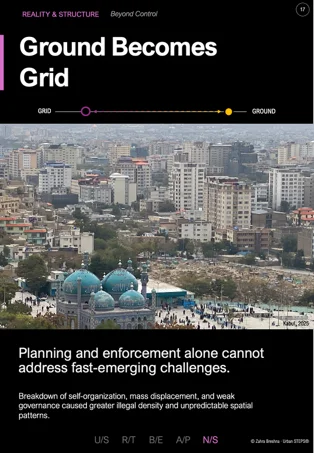
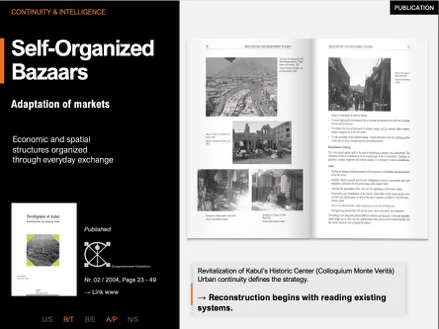
In Kabul, memory is contested terrain. The city has been written and overwritten so many times. What remains is not absence, but fragmentation: broken lines of continuity, fragile islands of recollection, and stories that persist in the margins.
This is not accidental. The erosion of memory is often not purposeful; it is part of a larger process: to control a city, one must first erase its past. In Kabul, this has taken many forms—military destruction, administrative neglect, the standardization of master plans that flatten difference, the disconnection between neighborhoods and their own history.
Erasure as a Tool of Control
In Kabul’s old quarters, informal dwellings grow out of ruined foundations. People still speak of gardens that no longer exist, of hammams that are now workshops, of public squares that became traffic bottlenecks. Each retelling is an act of urban resistance—a refusal to let the city’s inner logic be reduced to zoning codes or political expediency.
Memory as Living Infrastructure
At URBAN STEPS, we approach memory not as heritage in glass cases, but as a living urban infrastructure—invisible, yet structuring. We ask:
- How does memory shape spatial behavior?
- Where do communities archive their history when formal institutions fail?
- What can planners learn from the emotional geography of a place?
From Technocratic Planning to Relational Understanding
Our methodology invites a shift from technocratic planning to relational understanding. By working with local narratives, oral testimonies, and sensory mapping, we create frameworks where memory becomes a resource for transformation, not a burden from the past.
For cities like Kabul—fractured, informal, improvisational—this is not just important. It is essential. Because without memory, urban development becomes abstraction. Without memory, recovery becomes repetition.
We trace how cities carry memory not in what they preserve, but in what they rebuild.
Memory as A Starting Point
Cities do not forget; they carry memory in fragments, in what is rebuilt as much as in what is lost. To work with memory is not to romanticize the past, but to recognize its quiet persistence as a guide. In Kabul, and elsewhere, memory is not an echo—it is a starting point.
Related Atlas Cards:
Related Publications:
Related Methods:U/S, R/T
Framework Formation:PhD→DSAUH
Ongoing Inquiry:Urban Memory in Discourse (BFC)
Continue the Inquiry→
→Learn more in our Glossary of Critical Urban Terms
UrBan layers
Mapping Memory in a City That Forgot Itself
Memory Beyond Monuments
Urban memory does not reside in monuments.
It hides in pathways, alignments, and the unwritten logic of everyday space.
In Kabul, this memory lies buried—beneath asphalt, displacement, and fractured plans.
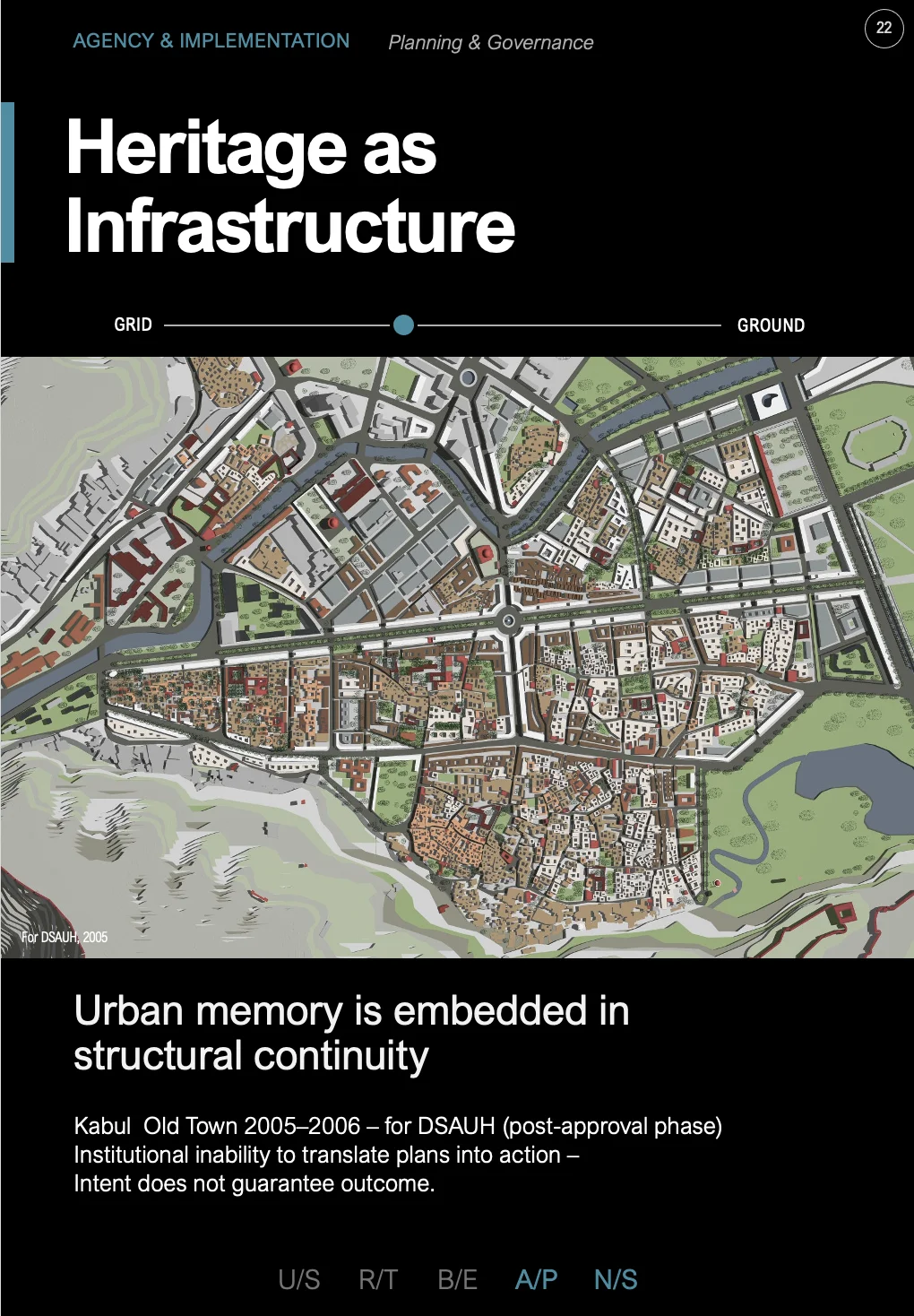
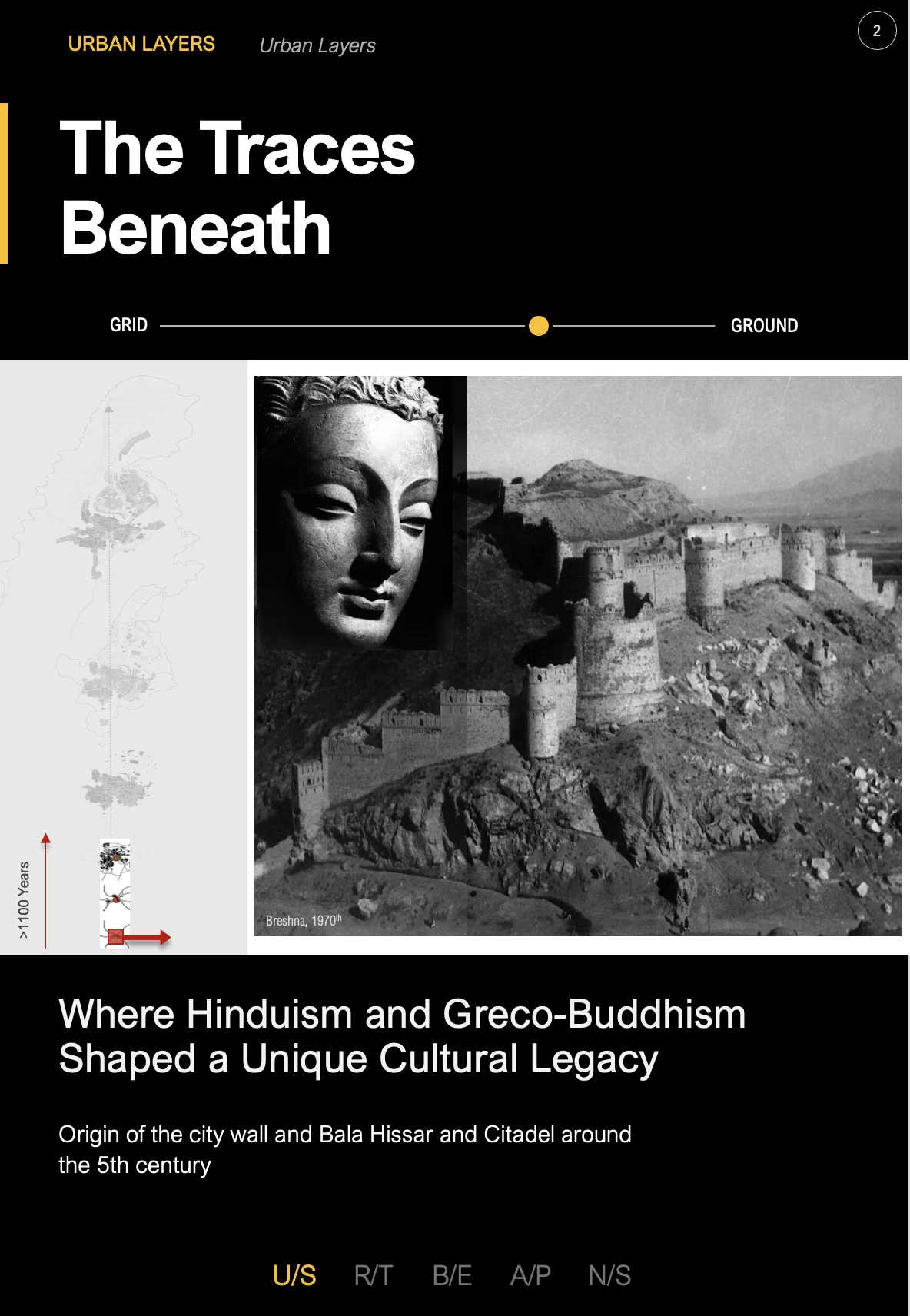
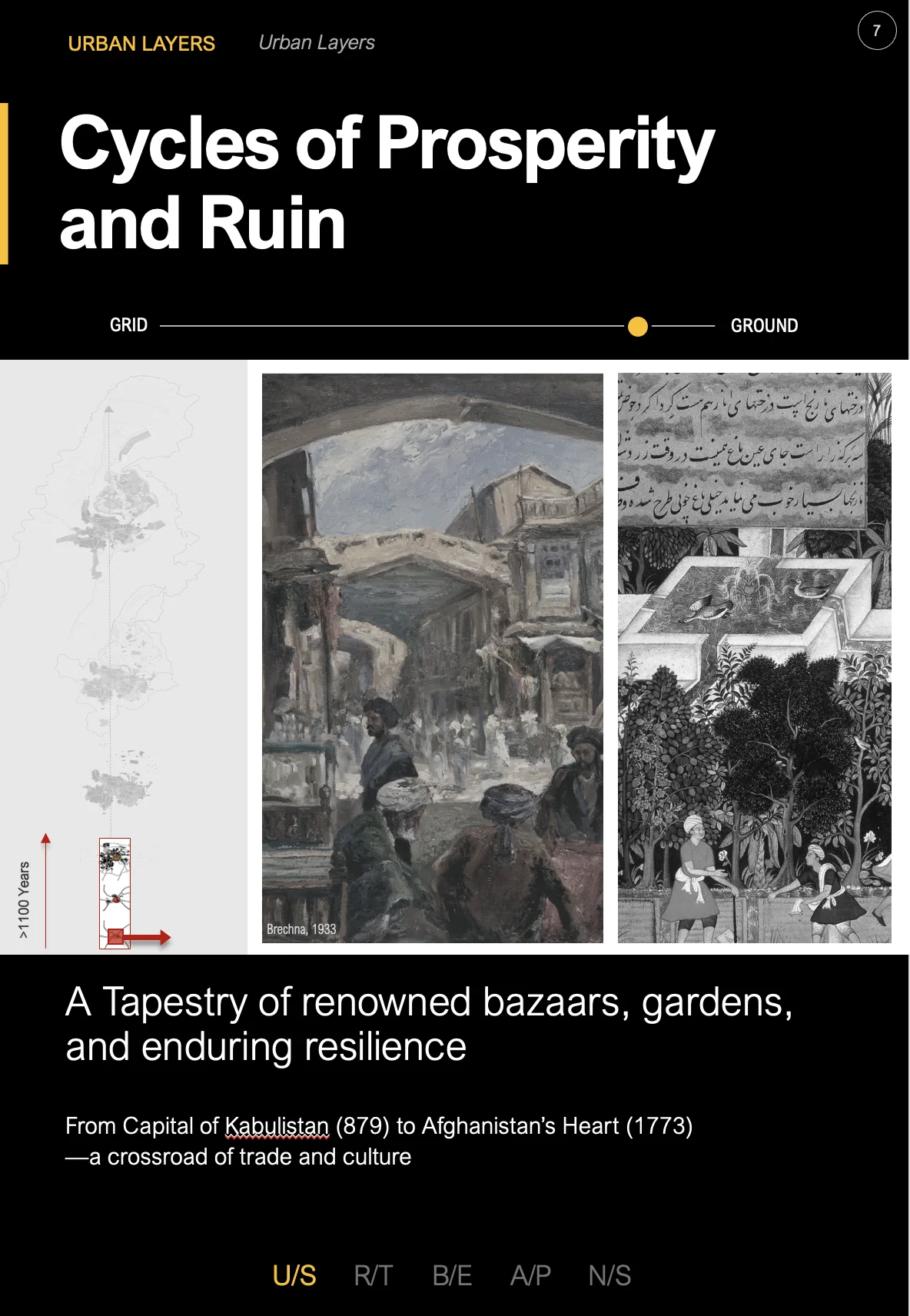
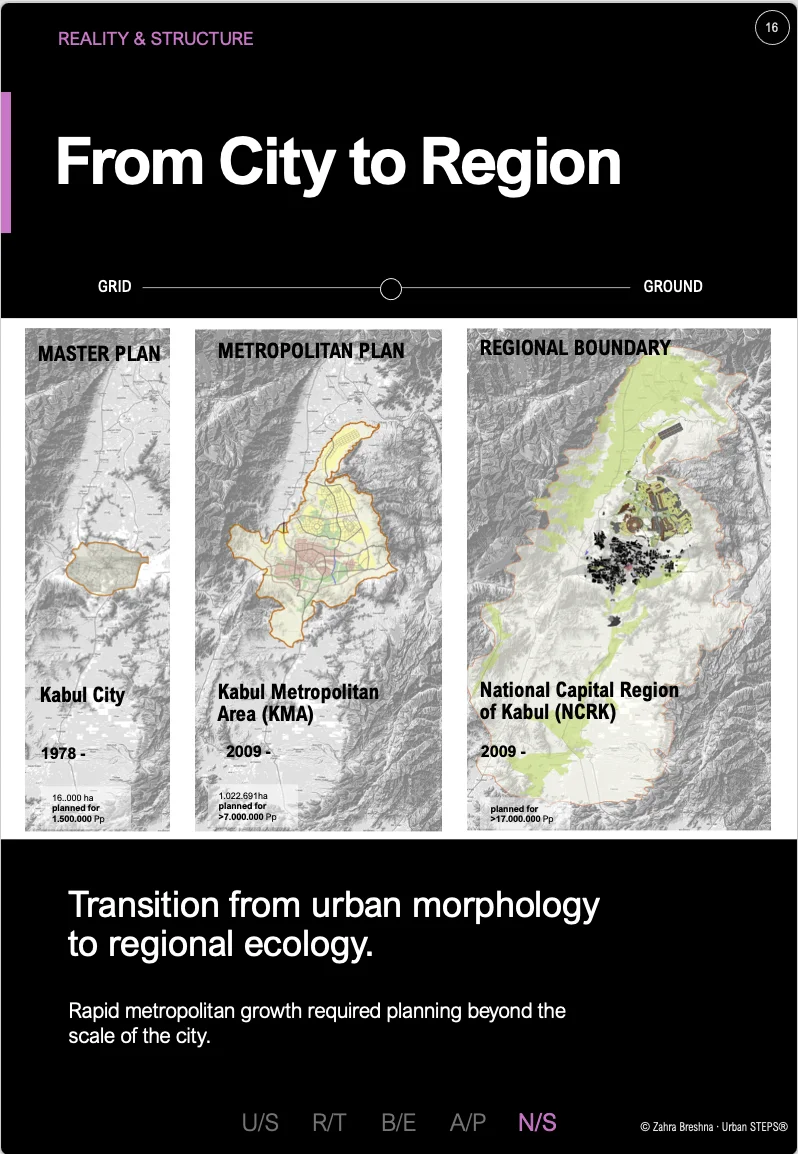
Kabul is a city built on the sediment of stories—some remembered, most erased. To walk its streets today is to sense the presence of what’s no longer visible: a layered cityscape of ruptures and continuities, resistance and reinvention. Research over the past two decades has focused on making these urban layers legible—not only through maps and models, but by tracing the lived memory embedded in Kabul’s historical fabric.
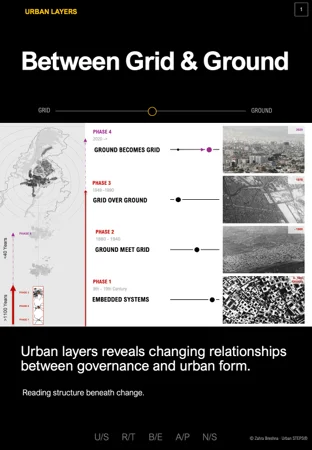
Until 1980 Kabul was a modern city that lived between the regulatory framework of the GRIDS and the lived experience of the GROUND, then shape-shifted to a fragmented postwar landscape then to a rapidly expanding informal metropolis struggling to retain its soul.
What happens when a city forgets itself? And more urgently: how can we help it remember—not nostalgically, but productively?
Mapping Layers of Time
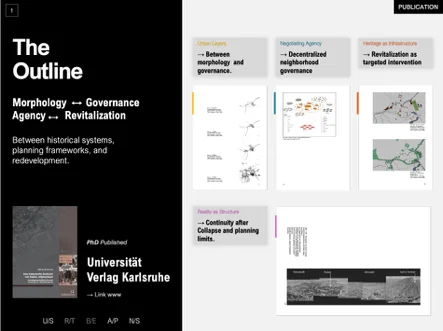
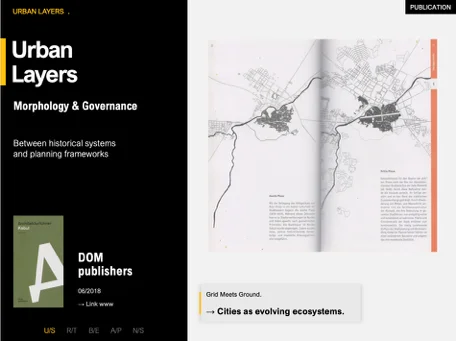
The project Urban Layers was born from these questions. Based on a series of analytical maps developed for PhD research and refined through fieldwork, oral history, and archival reconstruction, this work visualizes Kabul’s historical evolution across centuries. It distinguishes key phases.
This essay is part of an ongoing series exploring how cities remember, forget, and regenerate through their spatial DNA. Kabul is not the exception—it is a lens.
Each map is more than a static image—it is a diagnostic tool, a memory device, a call to action.
Memory as a Resource
But this is not just about Kabul. Cities in crisis—be it due to war, displacement, climate collapse, or authoritarian erasure—face a double loss: of material infrastructure and cultural memory. The latter is harder to quantify, yet essential for any sustainable future. We believe urban memory is not a luxury. It is a resource.
Towards Regeneration
The seriesUrban Layerswill unfold along thematic lines and our underlying methods —each entry exploring different aspects and context by connecting historical mapping with our ongoing research & application as well as publication and discourse, builds on our Urban STEPS conceptual backbone as an applied research, learning, and strategic framework for understanding and engaging complex urban systems in contexts of fragility.
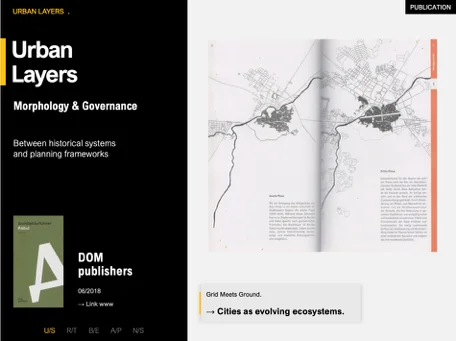
Together, they form a dynamic approach to read cities as evolving ecosystems—where tradition does not obstruct innovation but anchors it.
In Kabul’s case, memory is both fragile and defiant. Our maps show traces of a city that refuses to be flattened—by bombs or bureaucracy, ideology or indifference.
In reclaiming these urban layers, we do not simply look back. We build forward.
This essay lays the foundation for future essays in the Urban STEPS urban memory and urban layers series:
Related Atlas Cards:#1→15
Related Publications:
Related Methods:U/S
Framework Formation:PhD→DSAUH
What lies ahead are explorations of threads that continue to ask how cities can be resilient not by erasing difference, but by negotiating it.
- Urban Memory
What survives when place disappears?
Continue the Inquiry→
→Learn more in our Glossary of Critical Urban Terms
Join the dialogue. Shape the strategy. Walk the ground.
Material Logic I
Why We Forgot Earth—
and Why It Matters Again
From Material Logic to Practice
Humanitarian crises demand rapid action. Within hours, shelters must be erected, camps organized, and the most basic conditions for survival established. In this context, lightweight tents have become the global default: standardized, transportable, and immediately deployable.
Their logistical advantages are undeniable.
Yet in many regions, particularly those exposed to extreme heat, dust, or prolonged displacement, the limitations of tent-based responses become equally apparent. Thermal stress, lack of privacy, cultural mismatch, and repeated replacement cycles raise an uncomfortable question:Have we overlooked other material logics that deserve renewed attention?
Forgetting Earth
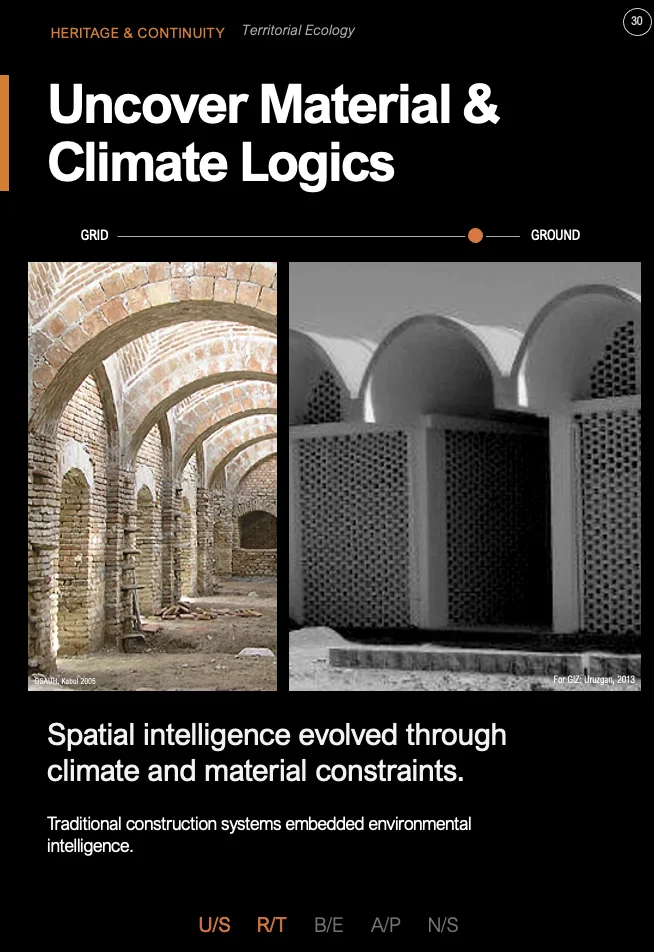
Earthen construction has sheltered communities for thousands of years across diverse climates and cultures. It is locally available, requires comparatively little embodied energy, and often provides superior thermal performance.
Despite these qualities, earth has largely disappeared from contemporary humanitarian shelter strategies.
The reasons are not purely technical.
Global aid systems depend on standardization, centralized procurement, and predictable logistics. Earthen construction is local, context-dependent, and shaped by climate, soil conditions, and community knowledge. What is difficult to standardize is often excluded—not necessarily because it performs poorly, but because it does not fit into existing operational frameworks.
At the same time, temporary plastic shelters align more comfortably with political expectations. They signal impermanence, support rapid deployment, and simplify procurement processes. Earth, by contrast, is often associated with permanence, even when designed for temporary use.
Beyond the False Choice
The debate is frequently framed as a choice between industrial tents and permanent housing.
This binary overlooks an important middle ground.
Urban and humanitarian responses rarely succeed through extremes alone. They require hybrid approaches that combine speed with adaptation, logistics with local capacity, and emergency response with cultural and environmental awareness.
In this sense, earth should not be understood as a nostalgic return to the past, but as one possible component within a broader material strategy.
Material as Strategy
The choice of material is never merely technical.
Materials influence thermal comfort, maintenance requirements, environmental performance, construction methods, cultural acceptance, and the degree to which affected communities can participate in rebuilding their own environments.
They also shape dignity.
A shelter is more than protection from rain or sun. It establishes privacy, orientation, identity, and the first conditions for restoring everyday life. Material decisions therefore become social and strategic decisions.
Temporality Requires Design
Recognizing the value of earth does not imply advocating permanent settlements in emergency contexts.
On the contrary, temporary shelter requires deliberate planning to remain temporary.
Open layouts, modular construction, basic but robust standards, relocation possibilities, and clear governance mechanisms can help prevent unintended permanence while preserving flexibility and dignity. Exit strategies are not an afterthought; they are an integral part of responsible humanitarian design.
From Material Logic to Practice
These reflections do not mean that earth should replace every humanitarian shelter system. Rather, they suggest that the current palette of responses may be unnecessarily narrow.
Projects such asMUD RESCU™ (Mud Reusable Emergency Shelter Cluster Units)explore one possible application of this broader idea: combining local materials, modular construction, climatic responsiveness, and temporary deployment within a structured humanitarian framework.
Whether such approaches prove successful depends not only on engineering, but also on governance, partnerships, testing, and continuous evaluation.
Relearning What We Unlearned
Perhaps the central question is not whether earth is an old material.
The more important question is whether modern humanitarian systems have become disconnected from forms of knowledge that remain relevant under contemporary conditions.
Earth is neither primitive nor universal. It is one material among many. But in an era of climate stress, mass displacement, and growing resource constraints, reconsidering its role may open new possibilities for more adaptive, locally grounded, and resilient forms of shelter.
The challenge is not to return to the past.
It is to rediscover what still works—and to integrate it thoughtfully into the strategies of the future.
Mud was never the problem. The system was never designed to remember it.
Related Atlas Cards:
Related Discourse:
Related Methods:U/S, B/E
Framework Formation:PhD→DSAUH→DCDA
Ongoing Inquiry:Territorial Webs, Material LAB, Pilot: Mud RESCU™→
What lies ahead are explorations of threads that continue to ask how cities can be resilient—not by erasing difference, but by negotiating it.
Continue the Inquiry→
→Learn more in our Glossary of Critical Urban Terms
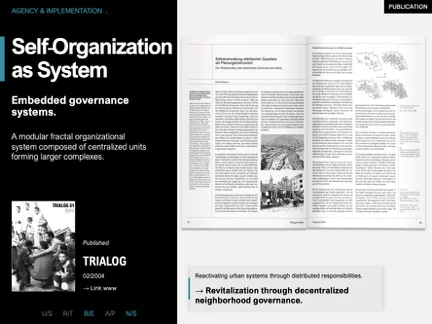
Self-Organization
THE Forgotten Order
“It was not absence that structured these neighborhoods, but the presence of responsibility, reciprocity, and embedded social control.”
Zahra Breshna, Kabul fieldnotes, 2004
In the fast-growing cities of the Global South, self-organization is too often conflated with informality —reduced to informal housing, market improvisation, or administrative failure.
Here lies the distinction: informality often describes survival in the absence of access, whileself-organization is an inherited framework.It imposes duties, not just rights. It is neither romantic nor nostalgic—it is demanding, participatory, and deeply relational.
To overlook this difference is to erase entire systems of urbanintelligence—what might be called the forgotten order.
Coexistence before the State
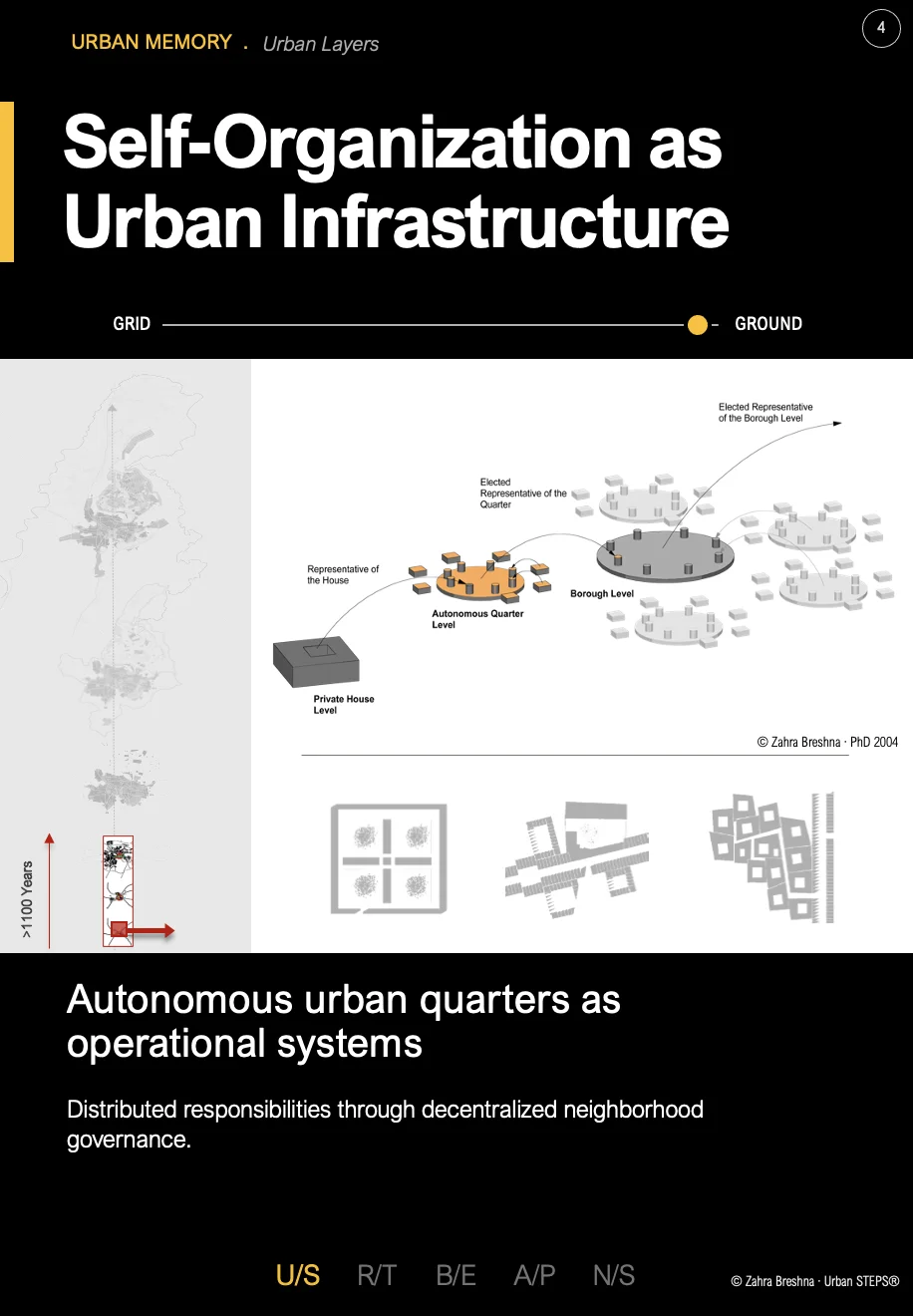
Before centralized administrations took hold, urban regulation in cities like Kabul was governed through a layered ecology of responsibilities:
- Wokilgozar(neighborhood representatives) mediated conflict
- guilds managed price stability and trade
- mosques and community elders organized care, safety, and sanitation
- property norms were negotiated through shared memory and moral obligation.
“Mechanisms of distribution in the alleys of Kabul did not primarily follow formal state directives but rather a social code that was based on fair use, respect, and reputation.”
Zahra Breshna, Kabul fieldnotes, 2004
These systems evolved through practice, negotiation, and collective ethics, forming a governance architecture both durable and dynamic.
From Regulation to Respect
This form of cultural regulation was never just about efficiency. It relied on “honor economies”—trust, reputation, and intergenerational learning. This is what allowed these neighborhoods to function even in the absence of external control. Self-organization, then, was not unplanned—it was differently planned.
What We Lost (And Can Learn)
Today, urban development programs often mistake self-organization for administrative failure—or attempt to replace it with participation models that ignore the power of embedded norms.
By failing to recognize self-organization, we overlook what cities already know how to do.
URBAN STEPS and the Return of Memory
URBAN STEPSdoes notseek to idealize self-organization, but to learn from it. We explore how these forms of“cultural cohabitation”might support more inclusive, flexible planning—especially in areas where state presence is limited.
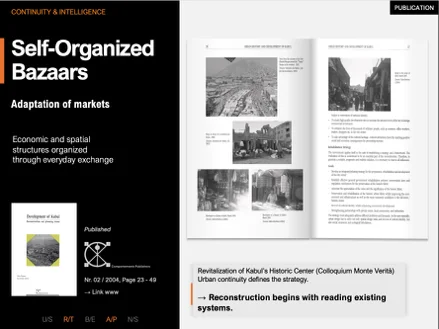
Our methods Uncover/Study (U/S) and Bridge/Activate (B/A)drawdirectly on these field studies: historical maps, neighborhood surveys, and the living memory of street-level planning. Through this lens, we understand cities not only as challenges tobe governed, butalsoas systems that have long governed themselves.
Recovering that memory does not mean turning backward; it means carrying forward a resource that cities already hold.
The question is not whether self-organization or a regulative framework should prevail, but how the two can meet in ways that allow cities to endure.
Related Atlas Cards:
Related Publications:
Related Methods:R/T, B/E, N/S
Framework Formation:PhD→DSAUH
Ongoing Inquiry:Self-contained Neighborhoods
What lies ahead are explorations of threads that continue to ask how cities can be resilient—not by erasing difference, but by negotiating it.
Continue the Inquiry→
→Learn more in our Glossary of Critical Urban Terms
Ongoing Research
& Applications
OPERATIONAL FIELDS
emerging from the Urban STEPS framework.
Contribute to Development
Concept Exploration
Self-contained Neighborhoods
Adaptive planning models informed by embedded urban systems.
Case Studies · Universities

Test & Apply
Open Research Field
Territorial Webs
Regional Systems Mapping. Exploring relationships between settlement, ecology, water and infrastructure.
Research · Case Studies · Academic Partnerships

Join the Dialogue
Open for Discourse
Breshna Foundation for Culture (BFC™) →
Archival, artistic, and urban memory systems as operational cultural infrastructure.
Research · Publications · Archive · Partnerships


Field Study
Strategic Intervention
Targeted activation within complex systems.
Case Studies · Universities · Municipal Partners

Concept Exploration
Agency Matrix
Implementation under fragmented institutional conditions.
Workshops · Practitioners · Institutional Dialogue

Funding Preparation
Pilot: Mud RESCUE™ →
Climate-adaptive systems for extreme territorial conditions.
Research · Labs · Funding · Partners

Join The Inquiry
WORK WITH URBAN STEPS
Urban STEPS is an evolving platform for research, reflection, and applied experimentation. We collaborate with researchers, practitioners, institutions, municipalities, cultural organizations, and funding partners interested in exploring complex urban realities.
Contribute to public discourse through lectures, workshops, and publications.
Collaborate on research, case studies, and framework development.
Explore pilot projects, training formats, and field applications.
- Research Partnerships
- Pilot Projects
- Workshops & Training
- Academic Collaboration
- Publications & Discourse
- Cultural Continuity Initiatives